
Our sailing area is certainly demanding, as we've said over and over again on this blog. But that's also what makes it so charming: renting a sailboat in North Brittany means having to deal with the tides, the winds and the rocks. One of the pleasures of sailing in North Brittany is unforgettable: running aground.
Living to the rhythm of the sea, landing where there's no one else, enjoying a secluded anchorage... has a very special flavor that will stay with you for a long time.
In this article, we share the fruits of 5 years of groundings in northern Brittany - first on a small Feeling 7.20 DL with crutches, then on an Ovni 40 - and above all our advice on how to run aground safely with a charter sailboat.
1. Wait for the right weather conditions.
It's not enough to decide to run aground; the elements must cooperate.
Beaching is the "level 3 or 4" of a sailboat cruise in North Brittany. The first level being to always have water under your keel, avoiding rocks at any time of the tide, and level 2 being to sail with the current to avoid surprises.
- The first essential rule: a flat sea and a spot well protected from the wind. A sailboat slamming from side to side as it lands is not pleasant... either for the crew or for the boat's structure.
- Watch for and anticipate wind shifts or current reversals. Your boat may move around its mooring and run aground elsewhere than planned. The whole area needs to be adequate - not just where you're moored at any given time.
2. Study the beaching area from every angle.
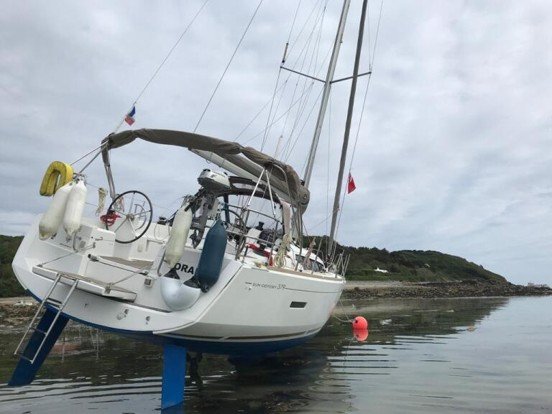
There's no room for uncertainty: the grounding is coming, and you need to gather as much information as possible.
- Study charts and tides: consult nautical charts, water levels and tide schedules - that's the basics!
- Check out the satellite views: Google Earth, Navionics or Google Maps display images at low tide. Useful for detecting rocks, sandy beaches or, on the contrary, pebbles or muddy areas.
- Use your hand-held probe to check the bottom around your yacht to see if the surface is flat and suitable. The hand-held sounder not only gives you an indication of the hardness of the ground, but also, by sounding all around the boat, allows you to detect a possible think or slope. Your electronic sounder will only give you a single reading.
- Consult boaters' opinions: apps like Navily provide interesting feedback, but be careful. The same spot may be perfect for a 25-foot dinghy, but not for a 45-footer. Or it may be suitable in one wind direction but not in another.
Don't take any risks: DIVE, and not just under the boat. Dive, dive, dive. Explore the entire area covered by your mooring. You're not safe from a current reversal that will shift your boat when you land.
Another technique is to arrive one tide earlier and observe the site on foot at low tide.
Beware of fluctuating sandbanks - the example of Mont-Saint-Michel.
Do you know why there are so few photos on the Internet of sailing boats grounded at the foot of Mont-Saint-Michel? The truth is, it's a very technical beaching. With its sandbanks and fluctuating riverbeds, running aground in the bay is a risky business. To guarantee a flat grounding, you have to get to the foot of the Mont, and to do that, you need ideal weather and high tidal coefficients. With falling coefficients, you could be stranded for several weeks.
3. Choose the right moment of the tide to run aground.
Arriving at low tide with a falling coefficient is the best way... to get stuck for several days!
It's best to arrive halfway down the tide, to give yourself some breathing space and observe the evolution of the water. Arrive quietly in 2 to 3 m of water, giving you time to study the area and move if you have the slightest doubt.
Beware, too, of spots protected by a rocky bar that open up at ebb tide: at high tide, the swell can make the ideal spot highly uncomfortable.
4. Adjust your chain length.
When you set up in 2-3 m of water, remember that when the sea rises, you could easily have 7 m more water than when you arrived. If you started out with 10 m of chain, remember to readjust the length to stay safe at high tide.
Always allow for at least 3 to 3.5 times the maximum water level. All Loc Voile Armor yachts are equipped with 70 m of mooring (40 m of chain and 30 m of rope).
5. Think about the technical items to check on your charter yacht.
Each boat has its own specificities. Of course, we're not talking here about raising the centreboard or rudders - that's a basic element! But also check the technical recommendations: some engines require the water inlet to be shut off to prevent sand or silt from being sucked in. Your rental company will be able to tell you what to do. And when you leave, always check that your engine spits out the water from the cooling system.
Bonus: Our favorite spots for easy beaching in North Brittany from Saint-Quay-Portrieux.
If you find yourself stranded, start with a marked and accessible site:
- The port of Erquy: beached on a white sandy beach at the foot of the lighthouse, with the village nearby. In July, you'll have a front-row seat for the fireworks.
- Bréhat(La Chambre or La Corderie): perfect visitor buoys for yachts under 10 m, in an idyllic setting.
Conclusion: a demanding but unforgettable adventure.
Beaching a sailboat in North Brittany requires a little technical skill, but offers an incomparable, timeless experience.
Whether you want to enjoy a beach all to yourself for the duration of a tide, or introduce your children to the magic of the rhythm of the sea, this is an experience that will leave its mark on your cruise.
Want to try beaching on your next cruise? Discover our beached sailboats(Yume, Corail, Perig, Eole) available for charter in North Brittany.